
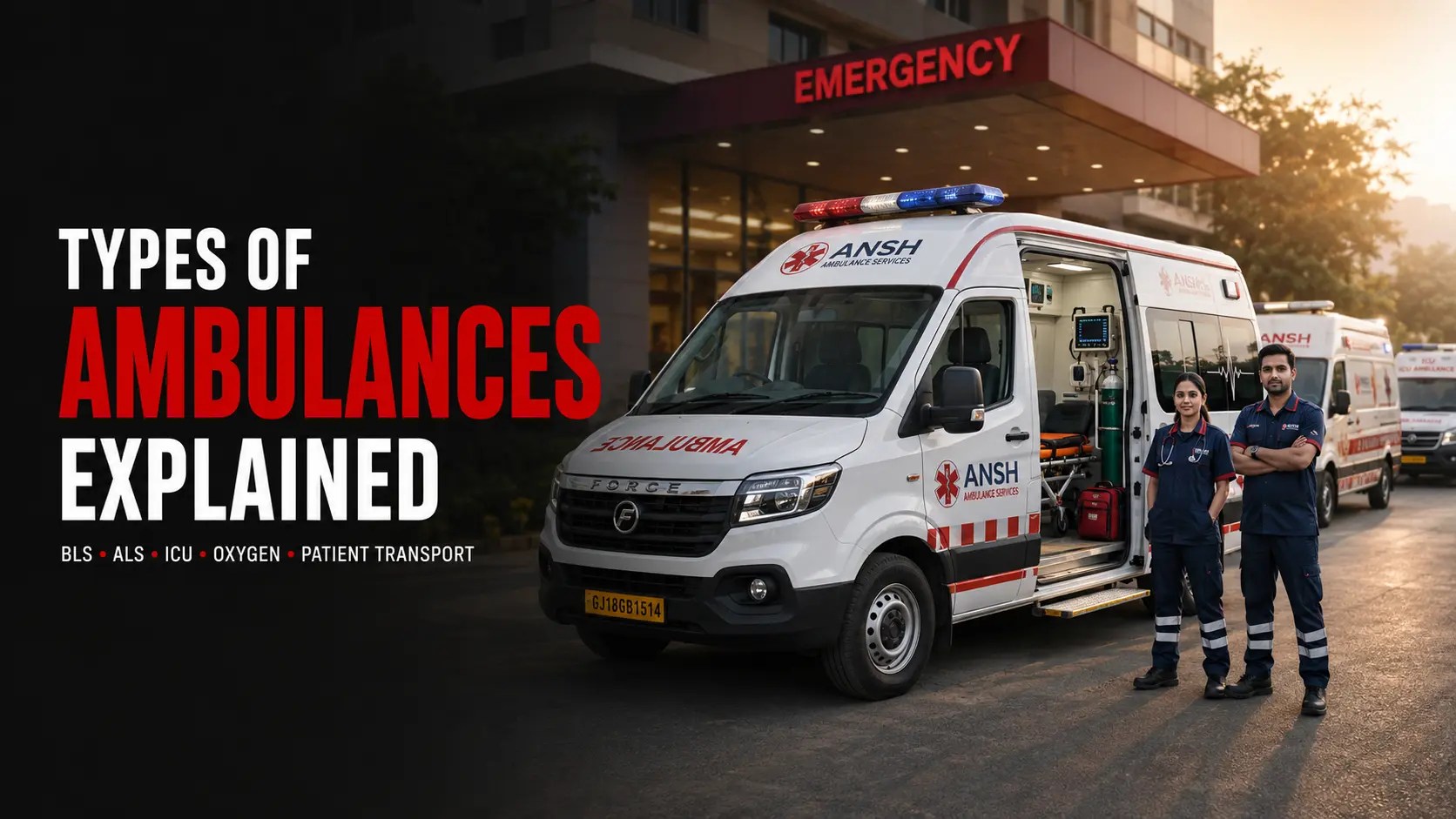
When a patient needs to be taken to a hospital, transferred between hospitals, or moved home after discharge, choosing an ambulance may seem straightforward. In reality, different patients can require very different levels of medical support during transport.
A stable patient who needs stretcher assistance may not need the same ambulance as someone who requires continuous monitoring or advanced airway support. Sending a vehicle with more equipment than necessary may add complexity and cost, while choosing an ambulance that cannot provide the level of care a critically ill patient needs can create avoidable risk.
In India, there is also an important distinction between the terms people commonly use when booking an ambulance and the country’s formal ambulance classifications.
Under India’s Automotive Industry Standard AIS-125 (Part 1), commonly referred to as the National Ambulance Code, road ambulances are classified according to the level of care they are designed to provide:
- Type A – Medical First Responder
- Type B – Patient Transport Vehicle
- Type C – Basic Life Support (BLS) Ambulance
- Type D – Advanced Life Support (ALS) Ambulance
Terms such as ICU ambulance, ventilator ambulance and oxygen ambulance are commonly used by hospitals, ambulance providers and patients to describe particular capabilities or services. They should not, however, be confused with the formal Type A–D classification.
This guide explains the differences and, more importantly, the questions families should consider when arranging patient transport.
Important: This article provides general information about ambulance categories and patient transport. The appropriate level of transport for a sick or critically ill patient should be determined by qualified medical professionals based on the patient’s condition.
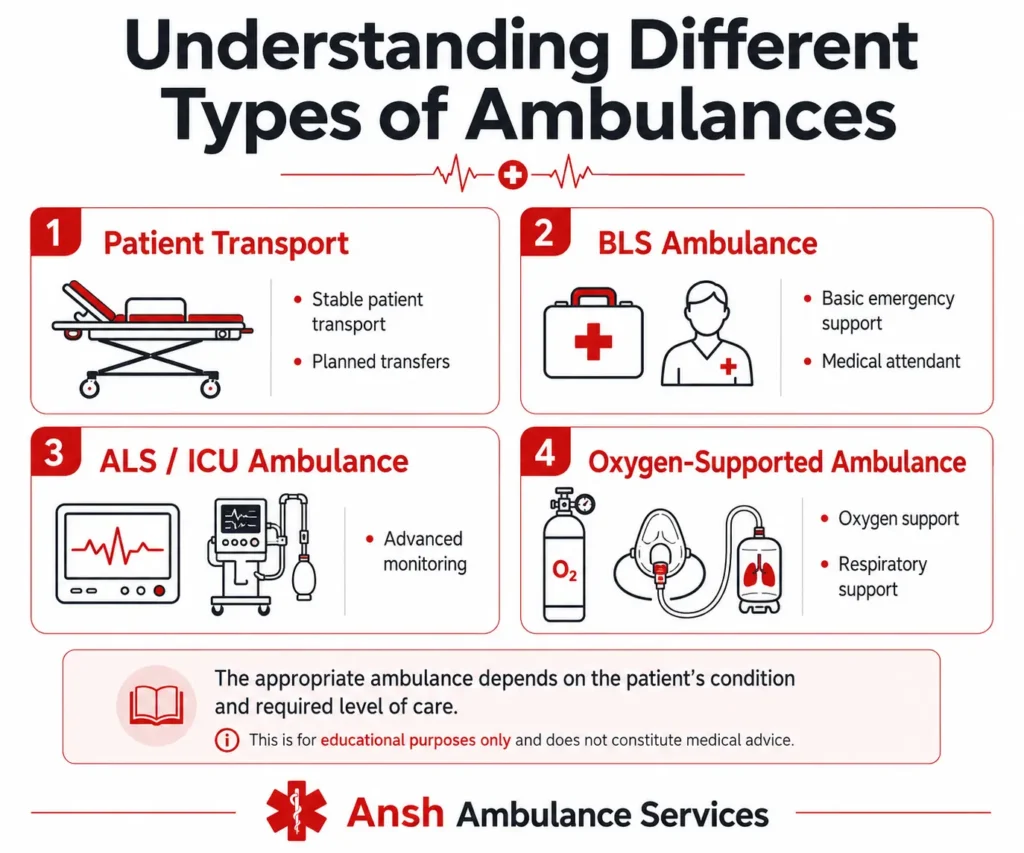
Why Are There Different Types of Ambulances?
An ambulance is more than a vehicle used to take somebody to hospital.
The World Health Organization describes prehospital emergency care as involving the rapid assessment, immediate management and transportation of patients to appropriate medical facilities. Effective ambulance systems connect care at the scene with healthcare facilities and also support transfers between facilities.
The amount of care needed during that journey varies considerably.
For example, consider three patients:
A person who has been discharged from hospital but cannot comfortably travel in a normal car may mainly require safe stretcher transportation.
Another patient may require oxygen and basic monitoring during transport.
A critically ill patient being transferred from one intensive care unit to another may require a much higher level of monitoring, airway management and clinical support.
This is why the ambulance should be selected according to the patient’s clinical and transport requirements, rather than simply asking for the largest or most expensive vehicle available.
1. Patient Transport Ambulance – Type B
A Patient Transport Vehicle (PTV) is classified as a Type B road ambulance under AIS-125.
The National Ambulance Code describes this category as an ambulance designed and equipped to transport patients who are not expected to become emergency patients during the journey.
That distinction is important.
A patient transport ambulance is not intended to replace an ALS ambulance for a critically ill patient simply because both vehicles can carry a stretcher.
When may patient transport be appropriate?
Depending on the patient’s condition and medical advice, patient transport may be considered for situations such as:
- planned hospital admission or discharge;
- transportation for diagnostic procedures;
- movement of a stable patient between healthcare facilities;
- patients who need stretcher-based transport but not advanced life support;
- some elderly or mobility-limited patients who cannot travel safely in an ordinary vehicle.
AIS-125 specifies that a Type B patient transport vehicle should have professional equipment appropriate for first aid and nursing care.
What families should check
Before arranging patient transport, tell the ambulance provider about the patient’s current condition rather than simply saying that a stretcher is required.
If a patient needs oxygen, active medical monitoring, airway support or other clinical intervention during the journey, a basic patient transport vehicle may not be the appropriate choice.
A doctor or other qualified healthcare professional should advise on the transport requirements where there is uncertainty.
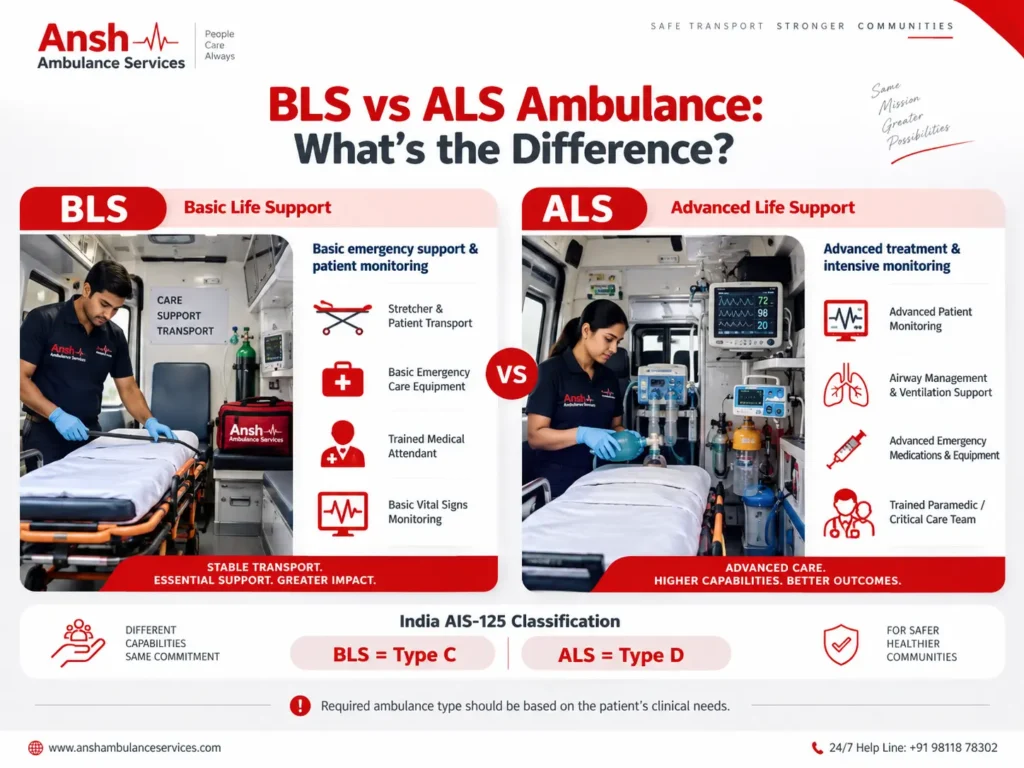
2. Basic Life Support (BLS) Ambulance – Type C
A Basic Life Support ambulance corresponds to Type C under AIS-125.
Government specifications describe a Type C BLS ambulance as being designed for emergency medical care and for providing basic life support during transport.
The National Ambulance Code distinguishes BLS from higher-level ALS transport through the type of treatment and monitoring the ambulance is intended to support.
India’s National Health Mission has similarly described BLS ambulances as being intended for patients who do not require ventilator support or cardiac monitoring at the ALS level.
What does BLS mean?
Basic Life Support refers to essential emergency-care capabilities used to support a patient before and during transportation.
The exact equipment and staffing available should always be confirmed with the individual ambulance service. An ambulance being advertised as “BLS” should not be assumed to contain every device a caller may expect.
As a general category, however, BLS transport is intended for patients who require a higher level of support than routine patient transportation but who do not require the advanced capabilities associated with ALS.
When might a BLS ambulance be considered?
The decision depends on the patient’s clinical condition, but BLS may be considered when a patient requires:
- emergency transportation with basic prehospital support;
- basic observation or monitoring during transport;
- non-invasive airway or breathing support within the BLS scope;
- stretcher transportation with trained emergency personnel;
- transfer where advanced intensive-care interventions are not anticipated.
The key distinction is not simply whether the patient is going to hospital. It is what level of care may be required before and during the journey.
3. Advanced Life Support (ALS) Ambulance – Type D
An Advanced Life Support ambulance is classified as Type D under AIS-125.
This is the highest of the Type B–D road-ambulance transport categories in the National Ambulance Code.
AIS-125 describes Type D ambulances as vehicles appropriately designed, equipped and staffed for emergency patients who may require advanced treatment and intensive monitoring, including capabilities beyond those expected in a BLS ambulance.
National Health Mission material also distinguishes ALS from BLS by noting the availability of capabilities such as ventilator support or cardiac monitoring in ALS services.
When might ALS transport be required?
ALS may be considered for seriously ill or injured patients whose condition requires advanced support during transportation.
Examples can include patients who require:
- advanced airway management;
- ventilatory support;
- intensive physiological monitoring;
- advanced emergency interventions;
- transfer between hospitals while critically ill.
These examples should not be used by families to self-select treatment. The patient’s doctor or the appropriately qualified emergency team should determine what support is necessary.
ALS does not simply mean “more equipment”
One of the most important points for families to understand is that advanced equipment alone does not provide advanced life support.
WHO’s current guidance for ambulance systems treats trained providers, appropriate equipment and medications, clinical protocols, medical oversight, communication, dispatch and structured handover as interconnected parts of effective prehospital care.
So when arranging transport for a critical patient, asking “Does the ambulance have a ventilator?” is useful, but it should not be the only question.
Also ask who will accompany the patient and whether the required clinical support can actually be provided throughout the journey.
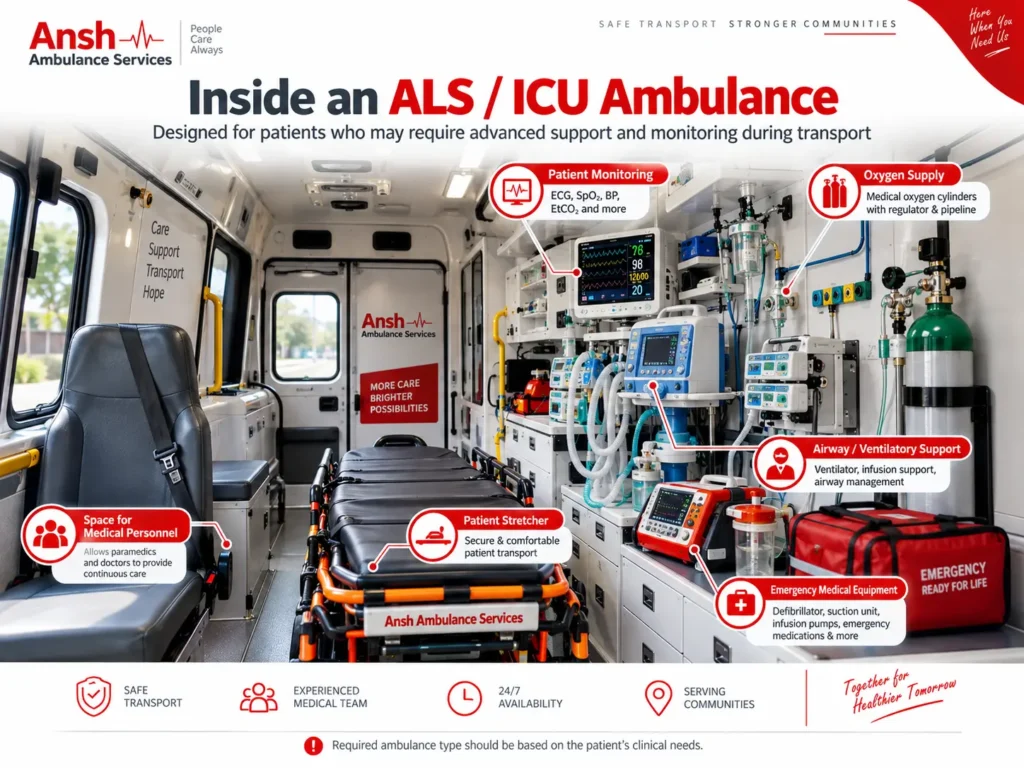
4. What Is an ICU Ambulance?
ICU ambulance is a term frequently used in India for an ambulance configured to transport critically ill patients with intensive-care-level equipment and support.
However, families should understand an important technical point:
“ICU ambulance” is not a separate Type E category under AIS-125.
Where the transport involves advanced life-support capabilities, the relevant formal road-ambulance category is generally Type D ALS.
The phrase “ICU on wheels” is also commonly used to describe highly equipped ALS ambulances, but it should not be interpreted to mean that an ambulance is identical to a hospital intensive care unit.
A hospital ICU has a much broader clinical environment, multidisciplinary staffing and access to diagnostic and therapeutic resources that cannot simply be reproduced inside a vehicle.
When may ICU-level ambulance transport be considered?
Typical situations can include:
- transfer of a critically ill patient between hospitals;
- movement from one ICU to another facility with higher-level care;
- transport of a patient who requires ventilatory support;
- long-distance movement of a medically complex patient;
- transfer where continuous advanced monitoring is required.
The exact transport plan should be decided by the treating team.
Before an ICU transfer, ask:
What support does the patient currently require?
The sending hospital should identify the patient’s current clinical requirements.
Can that support continue during transport?
Confirm that the ambulance’s equipment and accompanying personnel match those requirements.
Is the receiving hospital ready?
For an inter-facility critical-care transfer, communication and handover between facilities are important parts of safe transport.
WHO’s prehospital guidance specifically recognizes structured referral, transfer and handover as important components of emergency-care systems.
5. What Is an Oxygen Ambulance?
“Oxygen ambulance” is another commonly used service term, but it is not a standalone AIS-125 road-ambulance classification.
Oxygen capability can form part of an appropriately equipped ambulance depending on its designated level of care.
Therefore, simply seeing the words oxygen ambulance does not tell you whether the vehicle is a Type B patient transport vehicle, Type C BLS ambulance or Type D ALS ambulance.
This matters because two patients who both need oxygen may have very different medical requirements.
One may be clinically stable and need supplemental oxygen during a planned transfer. Another may have serious respiratory compromise and require advanced airway management, ventilation and continuous monitoring.
Those are not equivalent transport situations.
Questions to ask when booking an oxygen-supported ambulance
Tell the provider:
- why the patient is being transported;
- whether oxygen has been prescribed or is currently being administered;
- the patient’s current oxygen requirement, if specified by the treating team;
- whether the patient requires monitoring;
- whether other medical equipment is being used;
- whether the transfer is local or long-distance.
Do not independently change a patient’s prescribed oxygen flow or medical treatment based on information from an ambulance website. Follow instructions from the treating medical team.
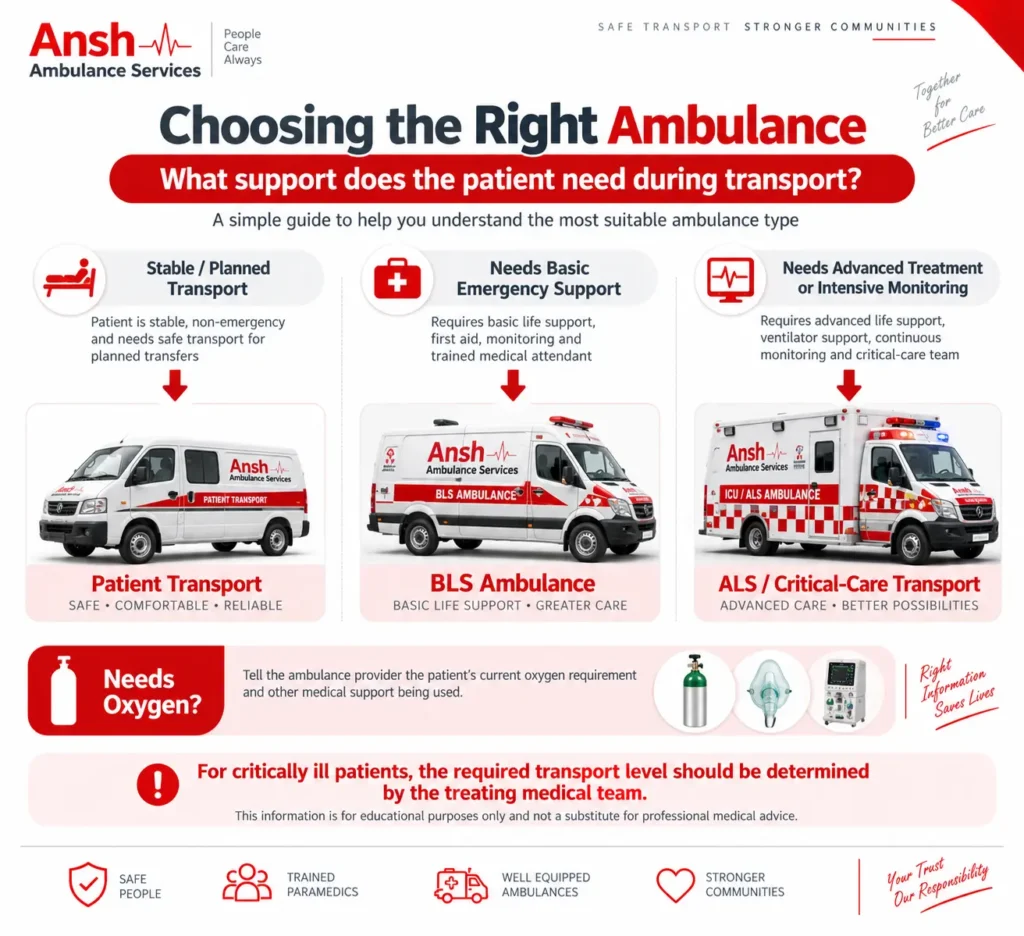
BLS vs ALS vs Patient Transport: The Simple Difference
The easiest way to understand India’s principal transport categories is:
| Ambulance | AIS-125 Category | General purpose |
|---|---|---|
| Patient Transport Vehicle | Type B | Transport of patients not expected to become emergency patients |
| Basic Life Support Ambulance | Type C | Basic emergency treatment and monitoring during transport |
| Advanced Life Support Ambulance | Type D | Advanced treatment and intensive monitoring for emergency/critical patients |
There is also Type A – Medical First Responder, which is intended to provide emergency out-of-hospital care but does not have the same supine patient-transport function as Types B–D.
The correct category should ultimately be based on the patient’s clinical needs.
How Do You Know Which Ambulance a Patient Needs?
Families should not be expected to make complex clinical decisions themselves.
A useful starting point is to communicate clearly with the treating doctor, hospital and ambulance provider.
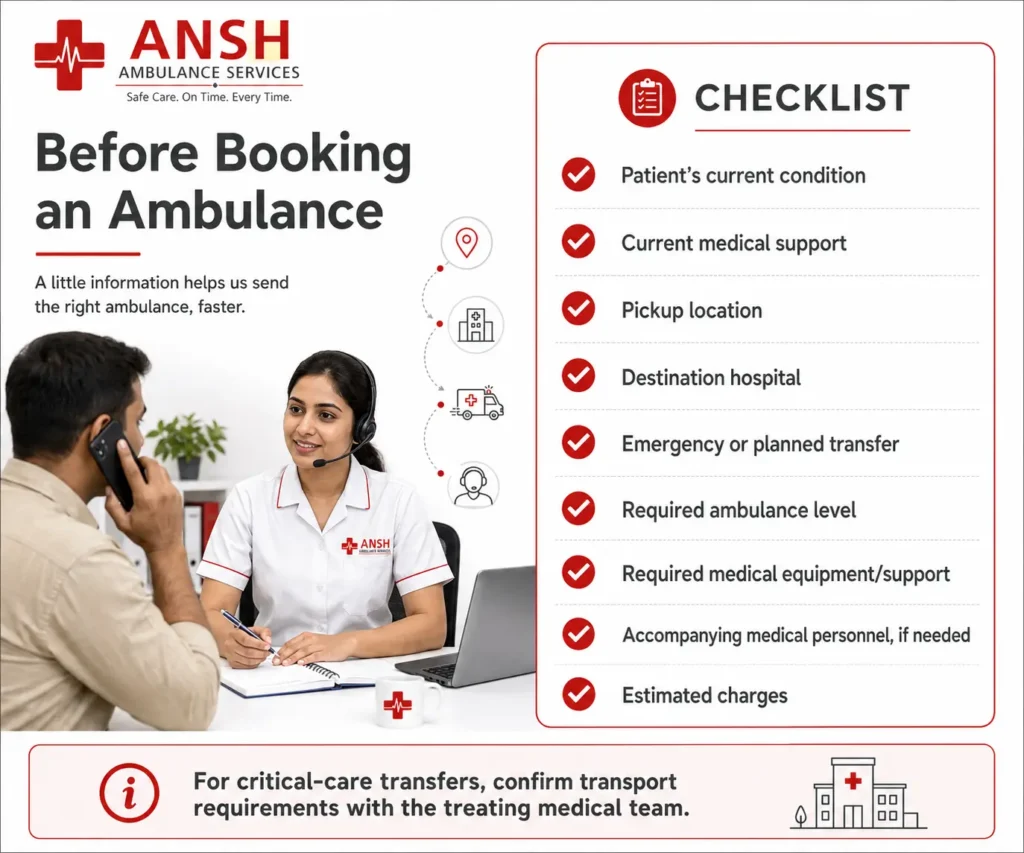
Before booking, be prepared to share:
1. The patient’s current condition
Explain whether the patient is stable, conscious, experiencing breathing difficulty, critically ill, recovering after treatment, or being discharged.
2. Current medical support
Tell the provider whether the patient is currently receiving oxygen, ventilation, IV therapy or other support.
3. Pickup and destination
A transfer from home to a nearby hospital may have different logistical requirements from a hospital-to-hospital transfer over hundreds of kilometres.
4. Whether the transfer is urgent
Make it clear whether this is an emergency or a planned transfer.
5. Advice from the treating doctor
For ICU and other medically complex transfers, ask the treating team what level of monitoring, equipment and accompanying medical personnel are required during transport.
This information allows the provider to assess whether patient transport, BLS or ALS capability is appropriate.
What Should You Check Before Booking an Ambulance?
For a planned transfer, particularly an ICU or long-distance journey, ask practical questions rather than choosing an ambulance based solely on price.
Consider confirming:
- the ambulance category and level of care;
- required medical equipment;
- oxygen availability where clinically required;
- monitoring capabilities;
- the qualifications or role of accompanying personnel;
- stretcher and patient-loading arrangements;
- how communication with the sending and receiving hospitals will be handled;
- estimated charges and what those charges include.
For a critically ill patient, the treating medical team’s transport requirements should take priority over convenience.
Why the Right Ambulance Matters
WHO emphasizes that timely prehospital care and rapid transportation to an appropriate healthcare facility can save lives, reduce disability and improve long-term outcomes.
But “fast” should not be interpreted simply as choosing whichever vehicle can arrive first.
The objective of an effective ambulance system is to connect the patient with appropriate care during transport and at the destination.
A stable discharged patient may only need safe patient transport.
A patient needing basic emergency support may require BLS.
A critically ill patient requiring advanced airway or ventilatory support and intensive monitoring may require ALS-level transport.
The right choice is therefore based on clinical need, not the ambulance’s appearance or marketing name.
Choosing an Ambulance in Lucknow
If you are arranging ambulance transportation in Lucknow, provide the ambulance service with as much accurate information about the patient’s condition as possible.
For planned hospital-to-hospital or critical-care transfers, discuss the transport requirements with the treating hospital before booking.
Ansh Ambulance Services provides different patient-transport and ambulance options in Lucknow. Availability and suitability should be confirmed for the individual patient’s needs at the time of booking.
For ambulance availability in Lucknow, contact Ansh Ambulance Services directly and explain the patient’s condition, pickup location and destination so the appropriate transport option can be discussed.
Frequently Asked Questions
Is BLS the same as a normal ambulance?
BLS is a defined level of ambulance capability. Under India’s AIS-125 classification, a Basic Life Support ambulance is Type C, while a Patient Transport Vehicle is Type B. They are therefore not the same category.
What is the difference between BLS and ALS ambulances?
BLS ambulances provide basic emergency treatment and monitoring appropriate to their designated level of care. ALS ambulances provide advanced treatment and intensive monitoring capabilities for patients requiring a higher level of support. Under AIS-125, BLS is Type C and ALS is Type D.
Is an ICU ambulance the same as an ALS ambulance?
“ICU ambulance” is commonly used to describe critical-care ambulance transport, while India’s formal AIS-125 classification uses Type D Advanced Life Support ambulance for advanced treatment and intensive monitoring. When booking, confirm the actual capabilities, equipment and personnel rather than relying only on the term “ICU ambulance.”
Is an oxygen ambulance a separate ambulance category?
No. “Oxygen ambulance” is a commonly used service description rather than a separate Type A–D classification under AIS-125. The appropriate ambulance category depends on the patient’s overall medical needs, not simply whether oxygen is required.
Which ambulance is used for a stable patient?
A Type B Patient Transport Vehicle is designed for patients who are not expected to become emergency patients. However, the appropriate transport should be determined according to the individual patient’s condition and medical advice.
Which ambulance is suitable for a critically ill patient?
A critically ill patient may require Type D ALS transport where advanced treatment, airway support or intensive monitoring is necessary. The treating medical team should determine the required transport capabilities.
References and Medical Sources
This article was prepared using authoritative public-health and Indian ambulance-standard sources rather than relying on commercial ambulance descriptions.
- Automotive Research Association of India (ARAI) – AIS-125 (Part 1): Constructional and Functional Requirements for Road Ambulances. This is the key Indian standard used for the Type A, B, C and D classifications.
- Ministry of Health & Family Welfare / National Health Mission, Government of India – National Ambulance Service guidance and programme material. Used for the distinction between BLS, ALS and patient transport within India’s public ambulance system.
- World Health Organization – Prehospital Emergency Care: Operational Guidance for Ambulance Systems (2025). Used for principles relating to ambulance operations, prehospital care, equipment, medical oversight, clinical protocols, dispatch and handover.
- World Health Organization – Prehospital Toolkit. Used for the role of prehospital care in rapid assessment, initial management, referral and transport.
- WHO/ICRC/IFEM – Basic Emergency Care. Used for general principles relating to systematic initial assessment and management of acute illness and injury.